Azure AD Backup vs Entra ID Backup: Same Need, New Name
In this article
If you're new to Microsoft's cloud services, you might not know that Microsoft Entra ID used to be called Azure Active Directory. The rename was announced on July 11, 2023, with the change rolling out across Microsoft's admin experiences starting August 15, 2023.
It was an understandable move. The old name created real confusion between on-premises Active Directory and its cloud counterpart, Azure Active Directory. Miss one word and you're suddenly talking about a completely different system, with different infrastructure and different risks.
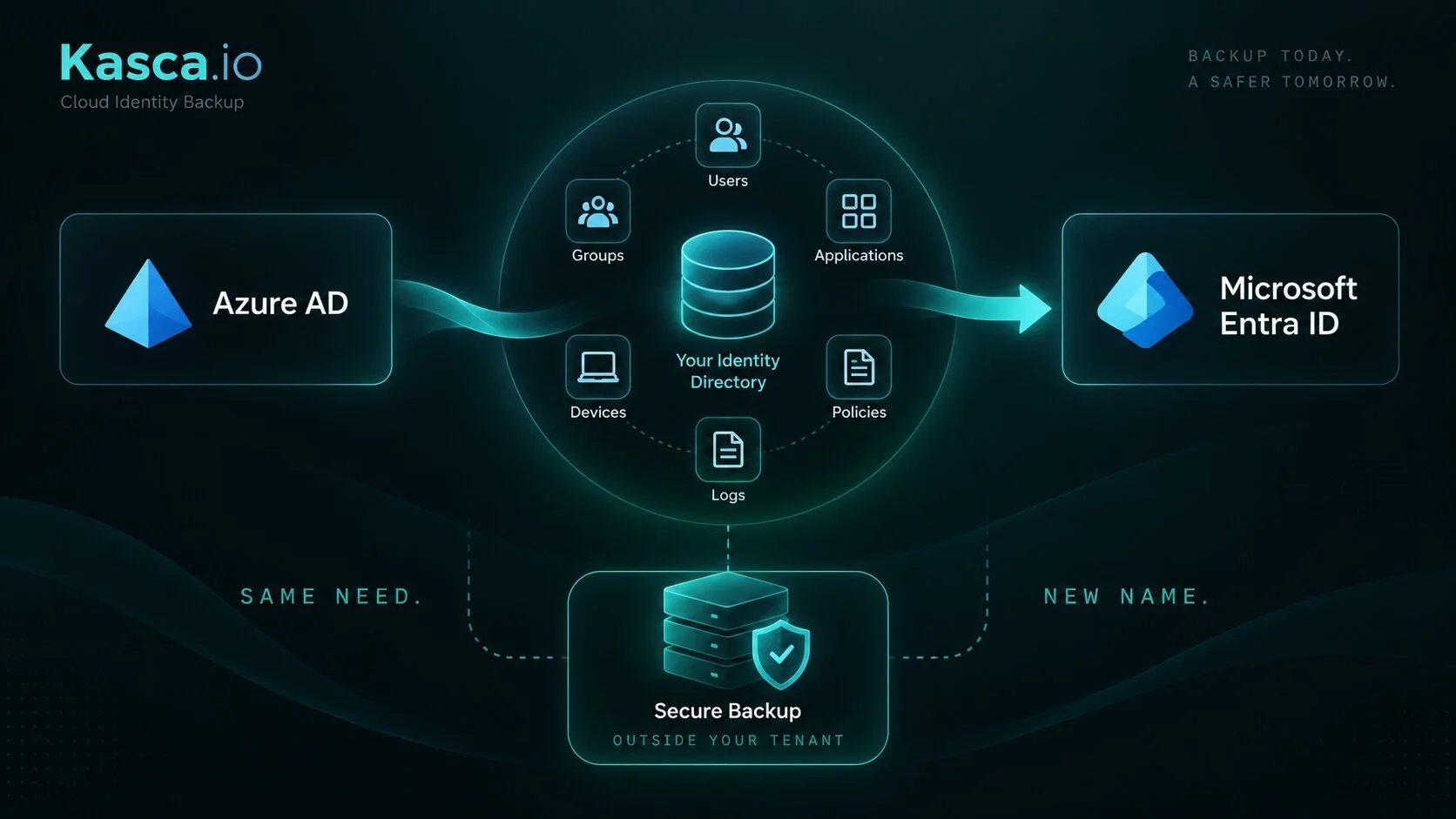
Is Azure AD the same as Microsoft Entra ID?
Yes. Microsoft Entra ID is the new name for Azure Active Directory. The rename did not create a new directory service or require customers to migrate their Azure AD tenants, so an Azure AD backup and an Entra ID backup are protecting the same underlying identity environment.
Strip away the name, and nothing about the underlying job changed. Azure Active Directory or Microsoft Entra ID, it was, and still is, one of the most important systems you run, the same way on-premises Active Directory is for your local network.
If anything, its role only grew. Conditional Access matured into the backbone of Zero Trust, Entra PIM brought structure to privileged access, and Entra ID Protection added risk-based signals like Risky Users and Risky Sign-ins that barely existed in the early Azure AD days.
The rename changed what Microsoft calls the platform. It didn't change what the platform does, what depends on it, or what happens when something inside it goes wrong.
Does Azure AD backup still exist?
The term does, even if the product name doesn't. If you're searching for Azure AD backup, Azure Active Directory backup, or Azure AD backup and restore today, the current Microsoft terminology is Entra ID backup and recovery.
That's an important distinction because the old search term still describes a very real problem.
Users still get deleted. Applications still get changed. Policies still get misconfigured. Scripts still run against the wrong object. The product name changed, but the need to recover identity state did not.
So if your team still says "Azure AD backup," nobody needs to stop the meeting and correct them. You're talking about backing up what is now called Microsoft Entra ID.
What has changed is that Microsoft itself now provides a native backup layer for parts of that environment.
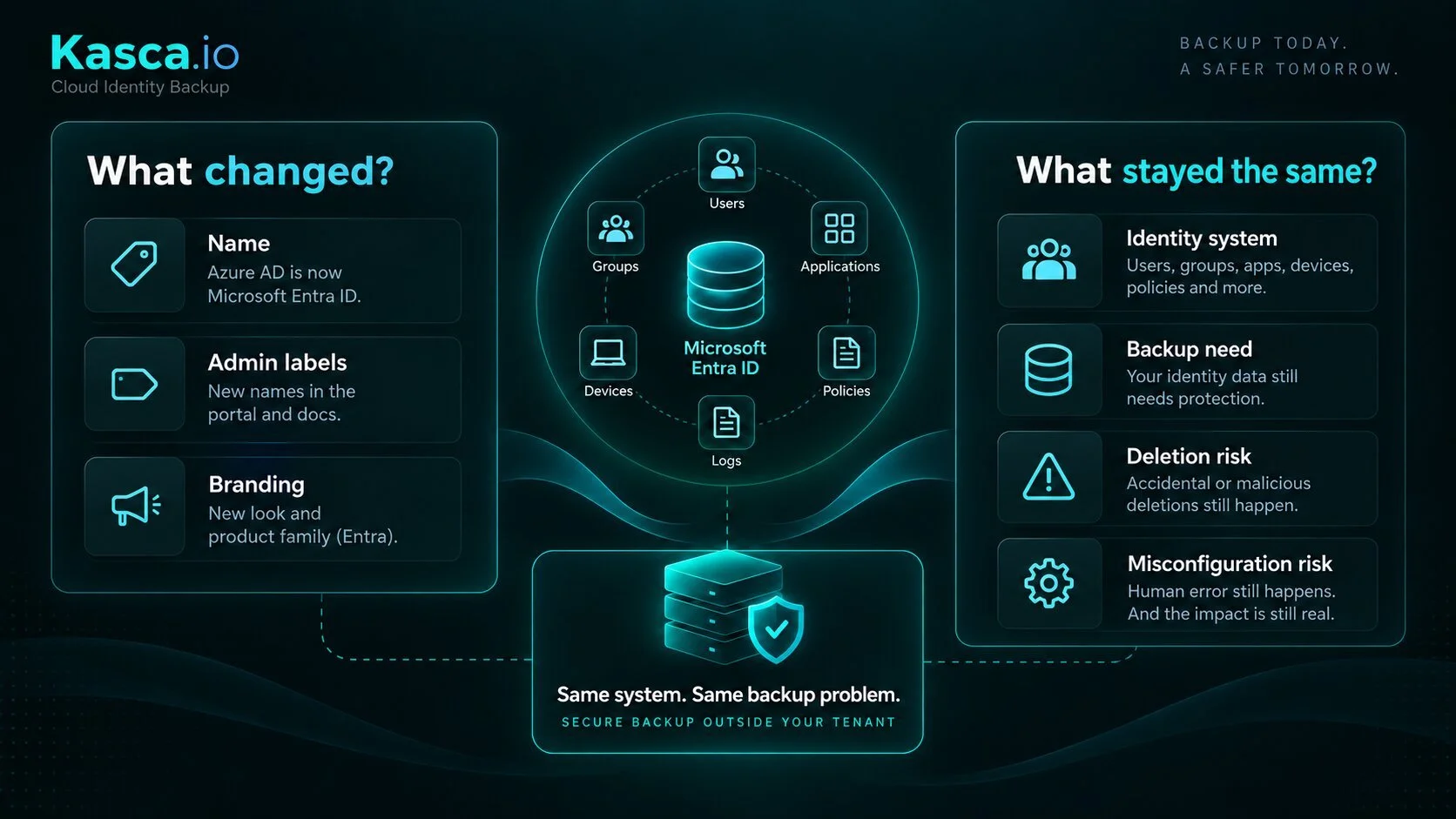
Azure AD backup is not the same as Azure Backup
The names are close enough to cause confusion, but they describe different recovery problems.
Azure AD backup, now more accurately called Microsoft Entra ID backup, is about protecting identity objects and configuration such as users, groups, applications, service principals and access policies.
Azure Backup is a separate Microsoft Azure service for protecting workloads such as virtual machines, disks, databases, files and on-premises servers. Backing up or restoring a traditional Active Directory domain controller is another separate scenario again.
So if you are looking for Azure Backup pricing, VM recovery or domain controller restore procedures, you are dealing with a different backup layer than the Entra ID protection discussed here.
What changed with Microsoft Entra Backup and Recovery?
Almost three years after the rename, Microsoft made the "same need" argument for you. On June 30, 2026, Microsoft Entra Backup and Recovery became generally available, bringing native backup and recovery capabilities specifically to Entra ID.
That's Microsoft, the company that owns the platform, confirming something security teams have been dealing with for years: protecting access and recovering identity state are two different jobs.
Conditional Access can stop a sign-in. PIM can control when someone gets privileged access. Identity Protection can flag risky users and risky sign-ins.
None of those things gives you yesterday's configuration back after somebody changes it.
Microsoft Entra Backup and Recovery now automatically backs up supported directory objects once per day and keeps up to seven days of backup history. Its current coverage includes areas such as users, groups, applications, service principals, managed identities, Conditional Access policies, Named Locations, and selected authentication and authorization configuration.
That's a meaningful change from the Azure AD days, when there was no equivalent native backup layer.
But backup coverage and a complete recovery strategy are not automatically the same thing.
A seven-day restore point can be useful when a bad change is spotted quickly. It says much less about an incident discovered weeks later, or about an object, property, relationship, or configuration that isn't covered by the recovery mechanism you're relying on.
That's why the conversation around Azure AD backup and recovery didn't disappear when Microsoft released its own tool. It just became more specific.
The question is no longer whether Microsoft Entra ID needs backup.
Now it's what needs to be recoverable, for how long, and from where.
The name changed. The blast radius didn't.
The oldest identity risk hasn't gone anywhere: a privileged user running the wrong script, deleting the wrong object, or pushing a policy change that locks out half the company.
That risk existed under the Azure AD name and it still exists under Entra ID.
What's changing is who's capable of making those changes.
Microsoft Entra Agent ID went generally available in April 2026, giving AI agents first-class identities inside Microsoft's identity ecosystem, with purpose-built authentication, authorization, governance, and security controls.
That makes sense. If an agent is going to act inside enterprise systems, it needs an identity, permissions, and accountability just like any other actor operating in the environment.
It also means the identity surface gets larger.
Delegate work to an agent, and that agent is now a named identity that can act, and act wrong, inside the same environment as everything else you run.
The point isn't that AI agents suddenly make Entra ID unsafe. Humans have been perfectly capable of breaking production environments without any help.
The point is that recovery matters more as the number of identities capable of taking meaningful action grows.
Whether the mistake comes from an administrator, an automation, a compromised account, or an autonomous agent doesn't change the recovery question afterward:
Can you get the previous state back?
What should Azure AD backup mean today?
If you're still using the term Azure AD backup internally, there's nothing wrong with that. The product behind the name is now Microsoft Entra ID, and the things you're trying to protect are still the identities and configuration controlling access to your environment.
A practical Microsoft Entra ID backup strategy therefore needs to think beyond the product name.
How far back do you need to recover?
Can you restore individual objects without rolling back unrelated changes?
What happens when something has been permanently deleted?
Which properties and relationships need to come back with the object?
Can configuration changes be reversed, not just object deletions?
And if the incident affects the tenant or the administrative identities inside it, how dependent is your recovery process on that same environment?
Those questions existed when the product was called Azure Active Directory. They still exist now.
Native Microsoft Entra Backup and Recovery gives organizations another recovery layer, and that's a major improvement. But the fact that native backup now exists doesn't remove the need to decide what your own recovery requirements actually are.
A company that needs seven days of history has a different problem from one that needs months.
A company comfortable keeping recovery entirely within Microsoft's platform has a different resilience model from one that wants an independent copy under its own control.
And a company that only needs to restore a recently changed user has a very different recovery problem from one trying to reconstruct identity state after a wider security incident.
That's why "Azure AD backup vs Entra ID backup" isn't really a product comparison.
They're the same need under two names.
Same directory. Same recovery problem.
Whatever you call the directory, the need hasn't moved. Something in it will eventually get deleted, misconfigured, or acted on by something that shouldn't have had the access it did.
The Microsoft Entra name reflects how much the platform has expanded since the Azure AD days. Native Backup and Recovery is an important part of that evolution too.
But renaming the platform didn't remove the operational risk, and adding native recovery doesn't remove the need to decide how resilient your own backup strategy needs to be.
If your recovery strategy is supposed to survive a tenant-level mistake or compromise, the recovery copy shouldn't depend entirely on the same tenant and control plane you're trying to recover.
That's the part of Azure AD backup that hasn't changed at all.
Go beyond native Entra ID recovery
Kasca is built specifically for cloud identity backup and recovery, with customer-controlled infrastructure, granular recovery, and long-term retention.
Explore how Microsoft Entra ID Backup can fit into a recovery strategy that goes beyond the native backup window.
Microsoft changed the name. The recovery problem stayed the same. Kasca adds a customer-controlled backup layer for Microsoft Entra ID, with granular recovery and long-term retention beyond the native backup window.
See how Kasca approaches Microsoft Entra ID Backup.
Go beyond the native backup window
See how Kasca adds a customer-controlled backup layer for Microsoft Entra ID with granular recovery and long-term retention.
Azure AD Backup and Microsoft Entra ID FAQ
Quick answers about the Azure AD rename, the difference between Azure AD backup and Azure Backup, Entra ID backup, and Microsoft's native Backup and Recovery capabilities.
Is Azure AD the same as Microsoft Entra ID?
Yes. Microsoft Entra ID is the new name for Azure Active Directory. The rename did not create a new directory service, and existing deployments, configurations, integrations, APIs, and identities continued to work without requiring a migration.
Does Azure AD backup still exist?
The term Azure AD backup is still widely used, even though Azure Active Directory is now called Microsoft Entra ID. Today, Azure AD backup, Azure Active Directory backup, and Entra ID backup generally refer to protecting the same cloud identity environment.
Is Azure AD backup the same as Azure Backup?
No. Azure AD backup, now more accurately called Microsoft Entra ID backup, focuses on protecting cloud identity objects and configuration such as users, groups, applications, service principals, and access policies. Azure Backup is a separate Microsoft Azure service for protecting workloads such as virtual machines, disks, databases, files, storage, and supported on-premises systems. Traditional Active Directory domain controller backup is another recovery scenario again.
Does Microsoft Entra ID have native backup?
Yes. Microsoft Entra Backup and Recovery is a built-in backup and recovery solution for supported Entra ID objects and configuration. Current coverage includes areas such as users, groups, applications, service principals, Conditional Access policies, Named Locations, and selected authentication and authorization settings.
How long does Microsoft Entra Backup and Recovery keep backups?
Microsoft Entra currently creates one backup per day for supported tenant objects and retains each backup for up to seven days. This native backup history is separate from soft-delete recovery windows that may apply to individual object types.
Is Azure AD backup the same as Entra ID backup?
In practical terms, yes. Azure AD was renamed Microsoft Entra ID, so an Azure AD backup strategy and an Entra ID backup strategy protect the same underlying identity service. What matters is the recovery coverage, retention, granularity, and independence required by the organization.
See how Kasca approaches Microsoft Entra ID Backup .